
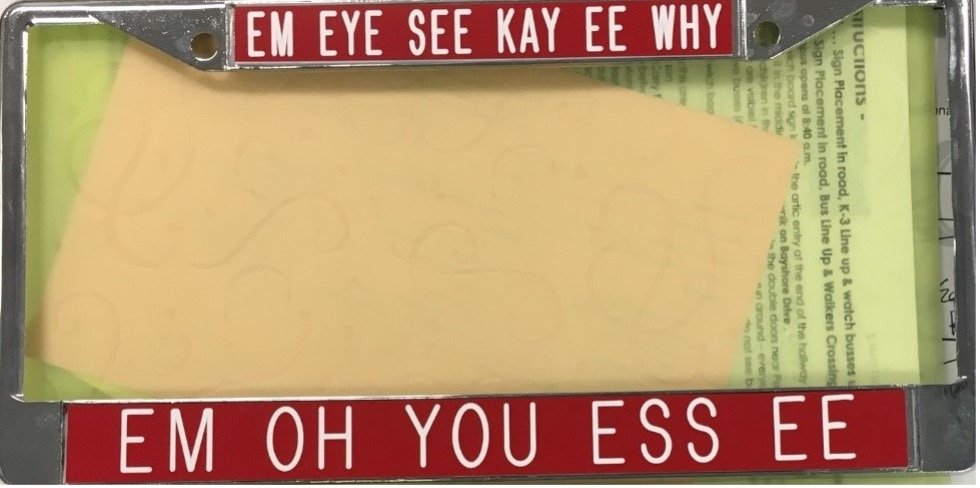
If you are older than 50, you will have no problem reading this license plate holder. If you are a millennial, it’ll take a while.
The point?
Every generation has terms and acronyms unique to their generation. If you grew up in the 1920s, you did NOT call someone a cowboy. In the 1930s, there was the real meaning of jazz. You had to have been alive in the 1940s to know what a 52/20 was. In the 1950s, there were zoot suits, and in the 1960s, if you were going as fast as you could, you were TEF. So LOL, millennials, don’t think you’ve ‘invented’ anything new; you’re just the next generation of wordmongers.
So, millennials, Generation Xers, hippies, whippersnappers, and old fogeys, let’s take a time machine back to the ‘good old days’ when carriage returns had nothing to do with airports, zoot suits sparked riots, and 23 Skidoo meant to beat feet.
[For the historical record, in 1903, when the first steel-structure high-rise was built in New York – the Flat Iron Building – no one believed it could stay erect. Crowds gathered to watch it tumble to rubble. It never did, and the building still stands. During construction, the rising building created a unique wind pattern that was strong enough to blow women’s skirts up. Police around the building on 23rd Street told the gathered men to “23 Skiddoo!” or, in modern terms, “Move along. Nothing to see here.”]
In the 1930s, an ‘all-nighter’ was a restaurant that stayed open all night. By the 1960s, it meant to study all night in preparation for an examination the next day.
In the 1810s, ‘at sea’ meant to be completely confused.
In the 1930s, to ‘be bananas’ meant to be crazy.
In the 1560s, ‘barnacles’ were glasses.
In the 1840s, a “barnburner” was a person or party wanting change so badly he/she/it ‘threw out the baby with the bathwater.’ The expression originally described someone willing to burn down a barn to get rid of the rats inside. Courtesy of linguistic evolution, today, a barnburner is a highly successful event. (The ‘rats’ presumably survived the gathering and probably had a good time.)
In the 1920s, someone ‘beat their gums’ by talking a lot. Today, that person is a blabbermouth, chatterbox, windbag, or ‘full of wind.’
In the 1920s, something very good was the ‘cat’s pajamas, ‘cat’s meow,’ or the ‘bee’s knees.’ In the 1930s, it was ‘berries.’ For the 1940s, it was ‘AOK.’ In the 1950s, it was ‘peachy keen,’ in the 1960s, it was ‘cool’ or ‘far out, man,’ and today, ‘I’m good’ or ‘most excellent.’
In the 1920s, a ‘bum’s rush’ meant to toss something out by force. By the 1960s, it was to ‘86’ something, and by the 1970s, ‘to get the boot.’
In 1910, ‘duck soup’ was something easy. By the 1970s, it meant something excellent, and in this decade, ‘crazy.’
The verb ‘go’ was/is linguistically adjustable. For the past century, it has meant to move or try, as in ‘give it a go.’ Paired with other words, there was/is ‘go steady’ and ‘go bananas’ from the 1930s, ‘go belly up’ from the 1940s, ‘go ape’ from the 1950s, ‘go ballistic’ from the 1960s, ‘go postal’ from the 1970s, and most recently, ‘go Titanic.’
In the 1950s, someone who was ‘slick’ was both capable and personable. Today, it means a conman.
Over the years, many cultural aspects have remained the same, but their descriptions have evolved. In the 1850s, ‘canoodle’ meant the same thing as ‘make out’ a century later. In the 1890s, a bumbershoot was an umbrella. In the 1830s, a chowderhead was Dumbo in the 1960s and today, an ID-10-T. In the 1950s, a church key was what we now call a bottle opener – but not a pop-top. Dust bunnies used to be called ‘beggar’s velvet.’ Then there was ‘stepmother weather’ (miserable weather), ‘Adam’s Ale’ (water), and ‘audit ale’ (a strong drink while your accounts are being audited).
Then there are terms that have outlived their usefulness. In the 1850s, a man who did ‘women’s work’ was a ‘Betty.’ In the 1910s, a ‘bimbo’ was a tough guy. In the 1920s, ‘bee’s wax’ was business. In sailing days, ‘fighting water’ was a cask of water placed on the deck of a ship about to go into battle. Having the water on deck kept men from going below for a drink. Once the cask was opened, a bit of vinegar was poured in to prevent too much water from being taken by one man. An ‘egg-wife-trott’ was an easy jog at the speed a farmer’s wife would go to market with eggs. A ‘cradle crown’ was a fine paid by a priest who had fathered a child or was keeping a concubine. A ‘bedswerver’ was an adulteress who swerved from the fidelity of her marriage bed. Then there are terms which are the same today as when they were popularized: butterfingers, butterflies in the stomach, higgledy-piggledy, high, hairy, skedaddle, and lollapalooza.
Historically interesting are words fingerprinting the realities – or unrealities – of an era, both of which are long gone.
In the 1850s, ‘leechcraft’ was the slang for the medical profession in spite of the fact that leeches were no longer ‘medically appropriate,’ to use a 2000s term.
In the 1840s, a ‘carpet-knight’ was someone who became a knight by kneeling on a carpet in front of the king rather than earning the honor by valor in battle. Today, we call these people ‘connected,’ NEPO, the ‘elite’ or ‘the privileged.’
As late as the 1910s, ‘verter-water’ was rainwater collecting in the hollows and depressions of tombstones, which was reportedly good for curing warts.
In the 1690s, ‘bunting time’ was the time of year when the grass was high enough to hide young men and young women engaging in sexual intercourse.
In the 1890s, long before the days of GPS, ‘bottle charts’ were used to create the nautical maps of ocean currents. A navigator would write down the latitude and longitude of his ship and the date and time on a sheet of paper. He would seal the paper in a bottle and toss the bottle overboard. When the bottle was recovered, it was sent to a map maker. Comparing where and when the bottles were thrown overboard with where and when they were discovered allowed the chart maker to estimate the speed and direction of ocean currents.
Also in the 1890s, a ‘bird duffer’ was someone who painted exotic plumage on live birds to increase their value.
To finish on a humorous note, there was ‘tapping the admiral.’ After Admiral Horatio Nelson was killed during the Battle of Trafalgar in 1805, his body was sent back to England in a rum cask. Legend has it that there was still rum in the cask, which sailors surreptitiously ‘tapped’ with straws.
To bridge the generational divide – attention, millennials! – here is a list of terms popular in the Dark Ages – those dark ages being when your grandparents lived. Why don’t you spend some time with grandpa and grandma discussing what these archaic words and terms meant?
down to seeds and stems
“film at 11”
“lay a patch”
carbon paper
card catalog
carriage return
eight track
fink
five o’clock shadow
four on the floor
Frick and Frack
Frito Bandito
gas wars
Georgia overdrive
hand signals, as in car hand signals
HiFi
home milk delivery
ice box.
juke box
limbo
linotype
liquid paper
matchbook
Mutt and Jeff
Nehru collar
P.F. Flyers
party line
PBX
pin feed printer
PMT
Polaroid
quadraphonic
Quonset
reel-to-reel
roller skate key
Rolodex
S&H Green Stamps
scrapple
seams, as in nylons
switchboard
Teletype
TEF
twist
typewriter ribbon