

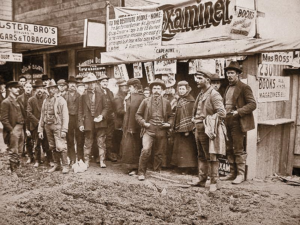
 This is one of those ‘usual’ photographs of Alaska Gold Rush: a bunch of men waiting for something. In this case it was 1900 in Nome just before the newspapers from the Seattle came in. Probably in the early days of June after the ice mantle on the Bering Sea broke. I can tell it’s late spring because the mud streets are still frosty. Which is why no one has mud on their boots. There are about 20 people in the photo, three of them women – a good random sample of the population. What I find particularly interesting – both historically and politically – is the sign “TO THE DESTITUTE PEOPLE – NOME.” I can’t read what it says but Nome was famous for the so-called ‘blue ticket.’ Since Nome was/is frozen in from about September 15th to June 1st, and if you had no money in 1900 you would have to spend the winter stealing to pay for food. So every September before freeze-up, Nome businesses took up a collection to buy steamboat tickets – blue tickets of the Alaska Steamship Company – to send the destitute to Seattle. There was a homeless problem in Nome in 1900 and we have a homeless problem now. History is not the story of the past; it is a study of the future. Everything that HAS happened WILL happen again. History cycles and that, in a nutshell, unfortunately, is NOT how history is being taught in our schools – thank you very much textbook publishers who profit ahead of education.
https://bit.ly/2RsZ6N1, https://www.authormasterminds.com/steve-levi