
Every Alaskan has a bear story and almost every one of those stories falls into the category Alaskans refer to as bullchitna. But there are some that are so strange they could only be true. One of these stories takes place in the small bush community of Takotna, a village about 45 minutes by air from
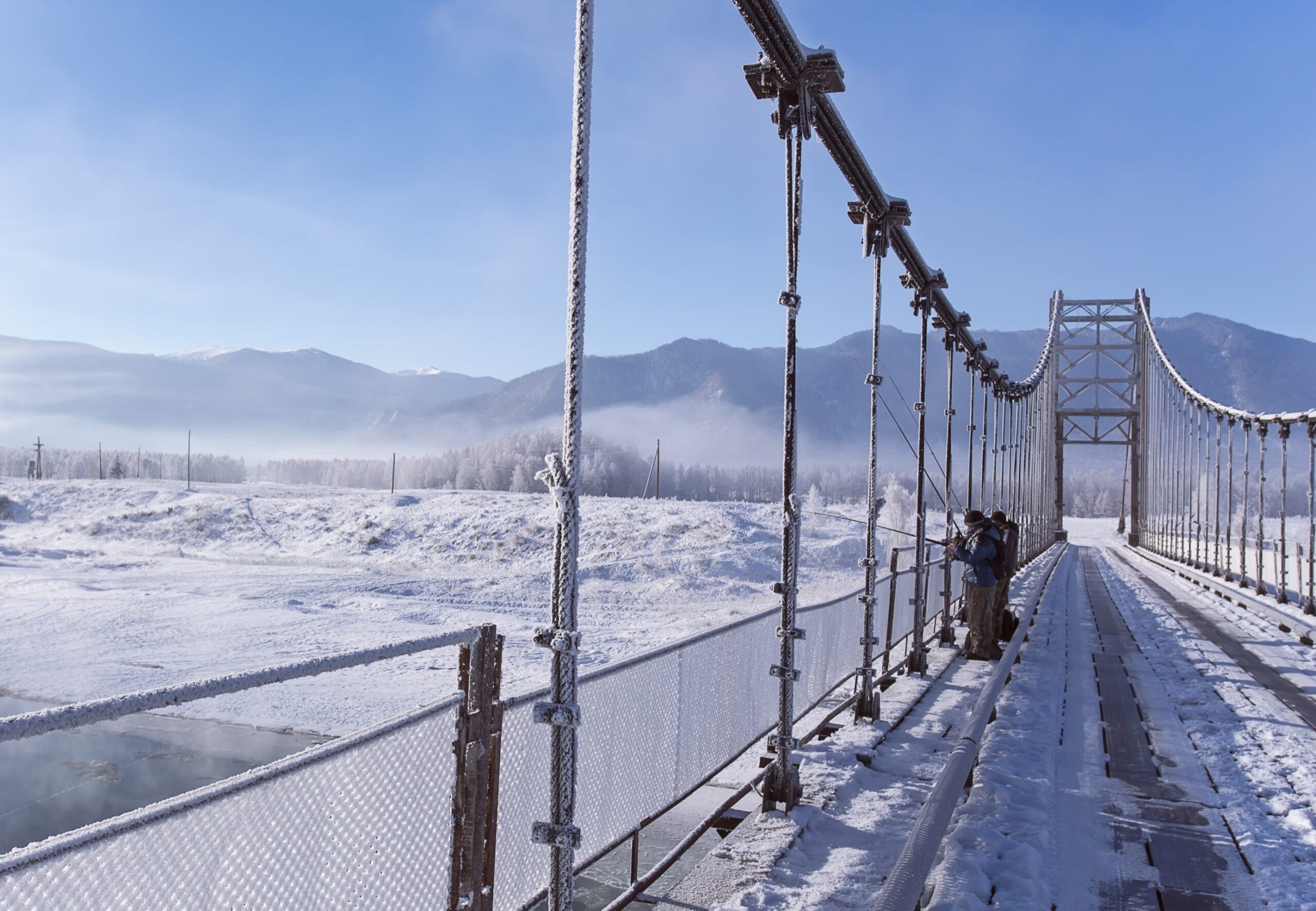
McGrath, a slightly larger community in the Alaskan Interior. (McGrath is even large enough to have tap water and an electrical utility.) Takotna is at the end of a 20-mile dirt road, called the Takotna Road, which connects the village with the now abandoned Tatalina ACWS and eventually the Kuskokwim River. There is a single bridge on the Takotna Road. Since the Takotna Road crosses the Takotna River outside of the village of Takotna, it seemed only natural to name the bridge the Takotna Bridge – which the United States government, the builder of the bridge, did.
The bridge itself is a Corps of Engineers’ special, a functional structure consisting of a 50-foot span with steel girders rising from concrete buttresses on both banks of the river. Though the bridge shifts from time to time – due to water under the bridge, wind through the bridge and trucks on the bridge – the structure has served its purpose well for more than half a century.
The bridge is not only used by human traffic, it should be added, but by wildlife as well. Squirrels and rabbits scamper across the span and an occasional moose too stupid to figure a way off the bridge other than by crossing has been reported from time to time. (On the basis of intelligence, a moose is on a par with a turnip. A chicken, compared to a moose, has a Ph. D.) The most consistent species of wildlife to cross over the bridge – after the human species – are the black bears that plod the railroad tie bridge bed between the community and the garbage dump. These bears weigh about 200 pounds and like to spend their time leisurely pawing through refuse heaps in search of bacon rinds, Spam cans, chicken bones and coffee grounds. They gorge in the summer and hibernate in the winter. Brown bears, which weigh up to 2,000 pounds, do not frequent the area, much to the relief of both the black bears and residents of Takotna.
In the spring of 1974, like every spring that decade, “Kraut” Noonan showed up in Takotna. Kraut, who worked for the State Department of Airway Safety, was the runway inspector. Every spring he inspected air strip runways. He would make certain that the potholes on the runway were not too deep, approach lights not too blinding or landing strip shoulders too soft to support the weight of incoming airplanes. Every year he would appear in Takotna for a quick inspection of the air strip, survey the potholes he had ordered filled the previous year, dim the approach light he had dimmed the year before, and demand more gravel for the soft shoulders that he had demanded the previous year. Six weeks later he would be back to survey the same potholes, dim the same approach lights and demand more gravel for the same soft shoulders. In Juneau, this was known as the “Alaskan Merry-go-round.” The legislature paid people to merrily go around Alaska and tell people what they did not want to hear and how to fix a problem that would never be fixed but no one complained because the inspectors were paid, landing strips could not lose federal funding, and no one got hurt because only the locals used the strips and they knew where the potholes and soft shoulders were.
But every six weeks the drama would be repeated. Thus summer would pass, and then fall, when Noonan would stop his peripatetic activity and return to Anchorage until the next spring when the cycle would begin again. (In Alaska during the winter, ice filled the potholes, snow froze the soft shoulders and the long hours of darkness made the bright approach lights a blessing as long as the pilot did not stare into the glare for longer than a few seconds at a time.)
Upon his arrival every spring, Kraut would join the locals for a healthy blast in the only tavern in town which had no name. It was called The Tavern. Everyone in Takotna hung out at The Tavern. After all, Takotna, a village of no more than 30 structures with no electricity, no television and no radio, was exactly the place where one would drink and do so frequently. Since there was only one tavern in town, or, more correctly, “in village,” and everyone in town drank frequently, everyone who drank frequently did so at The Tavern.
In 1974, there was a late breakup. Kraut showed up on schedule but had to wait several days for the weather to clear before he could begin his inspection. Snow drifts were piled high around Takotna and the river was still frozen from bank to bank. There wasn’t much for Kraut to do but hang around The Tavern and, as he was a drinker, he did not object to the delay much.
The bartender, who was serving Kraut liberal portions of the local poison, dubbed a Takotna Martini, had been brewing a practical joke all winter. With Kraut, one had to wait for the right moment to spring a practical joke. So the bartender plied his pigeon delicately with Takotna Martinis. The Takotna Martini was served in what was called “Takotna Crystal,” an empty mayonnaise jar, and was composed of whatever liquor the bartender happened to use. Each Martini took about an hour to consume. Two Martinis in an hour and you were likely to end up tattooed, or married, or both.
Into the second Martini Kraut gave his host the opening for which he had been waiting all winter.
“Ever hear of a sand shark?” Kraut asked the bartender as he was serving another drink.
“Can’t say that I have.”
“Well, they got ’em in Southern California. Yup. See, once upon a time they had rivers down there. Then more and more people began using the water and the rivers went underground. When the water went underground, so did the sharks.”
“Sure,” said the bartender scornfully, “sharks swimmin’ around in the sand.”
“Well, not swimmin’.” Kraut took a bite of his Martini. They gotta move real slow. Gotta keep the sand out of their gills. Kinda work their way through the sand.” Kraut used his hand to illustrate a slow-moving shark inching its way through sand.
“Well, that’s fine.” Donahue poured Kraut another Martini. “You know we got snow fish here.”
“Sure.” Kraut eyed his host. “Robert Service wrote about ’em. Big ones. Catch ’em with snow worms. Kinda like ice fishing with ice worms. Got any worms here?” Kraut pawed through the ice floating in the neck of the mayonnaise jar.
“No, this is for real,” the bartender said as he baited his hook carefully. “At times like this, with a late breakup, you can actually catch fish in drifts of snow. See, when breakup comes late, the ice melts in place and the snow on top is so thick that the fish mistake it for the surface of the water. They actually swim into drifts of snow.”
“Sure. And you just go around and pick them up.”
“Nope. The ice is too rotten. You step on that ice and you go right to the bottom of the river. You gotta fish for ’em.”
“Fish!”
“No other way.”
“I’ll bet.”
“Tell you what,” the Bartender said reaching into his back pocket. “I’ve got twenty bucks here that says we can go snow fishing right now and catch a fish.” He took a twenty out of his billfold and put it on the counter.
“You got it.” Kraut pulled two sawbucks out of his pocket and put them on top of the bartender’s bill. “Gypsy!” Kraut turned to a staggering customer who was fighting tooth and nail with a mouthful of muktuk. “Hold these. I gotta see a snow fish.”
It didn’t take long to round up a fishing pole and by the time Kraut and the bartender got a dozen lures the entire village knew that the bet had been made. Kraut was quick to catch on that something was amiss but he was too far into the bet to pull out. Thus, with rod in hand he walked onto the Takotna Bridge. Behind him walked the bartender, Gypsy, and the rest of the Takotna villagers, all 37 of them. As Kraut moved out to the center of the bridge, the villagers followed him as well, except for one individual who beat feet across the ice under the bridge.
The bartender’s plot was simple. A frozen silver salmon had been hidden in a snowdrift on the far side of the river. A lure, exactly like the one Kraut was about to use, had been planted in its mouth and the fishing line from the lure ran across the ice and under the bridge. NO matter where Kraut fished, sooner or later he was going to cast in the direction of the hidden salmon. Then, as the line hung slack, the culprit beneath the bridge was going to cut Kraut’s line, attach the line with the salmon and then give the line a healthy jerk. By the time Kraut reeled the fish in, the knot would be so deep in the spool that he would never find it.
Since it was early spring, daylight was, in essence, twilight. With a deft flick of his wrist, Kraut sent the lure sailing into the dark. It took several casts before the line curled in the direction of the hidden salmon. The crowd “oooohed” and “aaaahed” until Kraut didn’t know whether he was being led on by the villagers or if he was indeed fishing with exceptional skill. Those thoughts vanished from his mind when he suddenly felt a hardy tug on his line. The villagers went wild with excitement which, of course, covered the sound of scurrying footsteps on the ice below.
Kraut had been completely fooled. He began reeling like a madman and there, skittering across the ice of the Takotna River plowing from one snow drift into another, was a huge silver salmon! He could not believe his eyes! All he could do was stare at the fish as it slid toward him across the ice. There were snow fish and he had just caught one!!
The bartender, smug in his calculations, thought he had accounted for every possibility. He was sure that daylight would be weak enough to obscure the stiffness of the “snow fish” yet, at the same time, be strong enough for the salmon to be seen as it skittered across the ice. And, of course, he was sure that he would win the bet. Every contingency had been covered.
Every contingency, that is, except for the 2,000 pound brown bear that broke out of a snow drift on the far side of the river and began chasing the frozen silver salmon across the ice.
In an instant the locals were moving up the girders of the Takotna Bridge with great speed. Any brown bear out at this time of year was one hungry critter and had a whole winter of not eating to catch up on. None of the locals cared to be his main course. Within moments of the appearance of the bear, the 39 villagers were sitting in the bridge girder like ravens in a rookery.
This was an unexpected turn of events. Bears were supposed to still be in hibernation. Apparently no had told this particular brown bear that, for there he was, in the flesh, one ton of it.
Despite the hubbub, however, Kraut had not taken his eyes off that fish. He just stared at the fish as he reeled it in. But because of the gloom and because the brown bear stayed a few feet behind the salmon, Kraut did not see the bear. In fact, he did not see the bear until he reeled the salmon up off the ice to take a good look at it. Just as the fish came within his grasp, he saw a massive, hairy, claw-filled paw reaching for the fish from beneath the bridge.
Kraut, understandably, snapped back. Unfortunately he failed to let go of the rod, and, as he jerked back, the fish jerked back as well. Only then did Kraut realize that he was the only human on the bridge. When he saw 2,000 pounds of brown bear pouring itself onto the bridge bed, he knew why.
At this point Kraut figured that if the bear wanted the snow fish, it could have the snow fish. Dropping the rod he scrambled up a girder trying to put as much distance and steel between himself and the bear as possible. But the bear wasn’t interested in him. The salmon was another matter. The bear wolfed the salmon down in three bites and sauntered off into the forest.
For the rest of the summer Kraut was the talk of Takotna. He had lost the bet, of course, for he had indeed caught a snow fish and no one in Takotna let him forget it – for years. The Tavern memorialized the bet with a drink named, naturally, the “Snow Fish,” which came with plenty of ice and a float of squaw candy. (Whenever Kraut came to town, he got his with a little plastic bear on the edge of his glass.) Although he steadfastly denies the veracity of this tale, everyone in Takotna knows that “Kraut” Noonan did indeed, on a spring afternoon in 1974, catch a snow fish at the Takotna Bridge.