
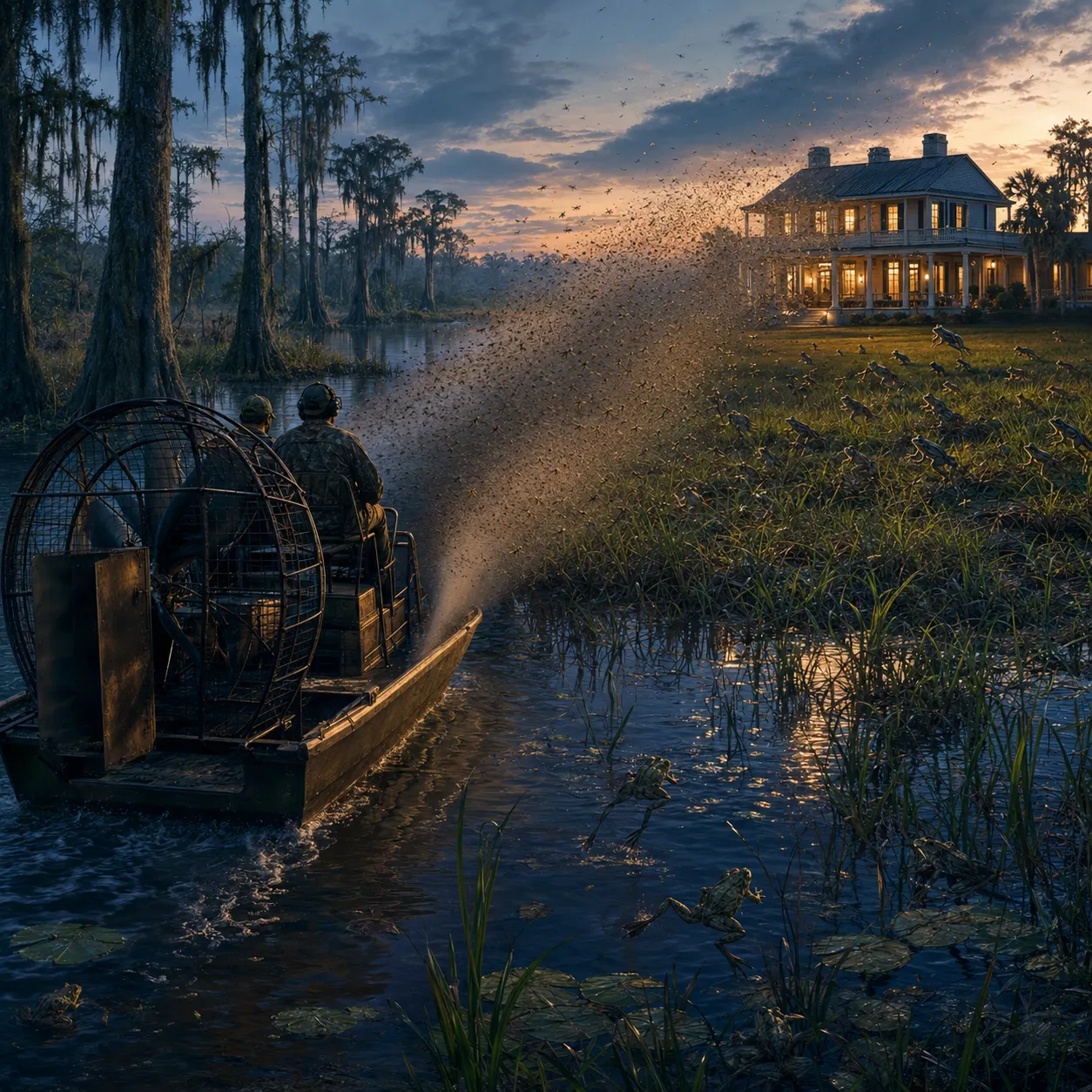
Heinz Noonan, the “Bearded Holmes” of the Sandersonville Police Department, was having a miserable day. It was not a day after a Naugahyde night or, for that matter, some assigned, meaningless, administrative task which had sent him scrambling hither and yon. It was, in fact, and unfortunately, a political call which had come down from on high. ‘On high’ in this case was from the third floor of the Sandersonville Municipal Building, which was, with overpriced, allegedly Persian carpets and deep leather chairs, the abode, throne room, and administrative domicile of the Sandersonville Commissioner of Homeland Security.
Today it was frogs.
A battalion of them.
Missing.
And they were not missing in the law-and-order sense of the term. As in kidnapped. This was because the call was from an individual related to the Sandersonville Commissioner of Homeland Security, who was having a problem with frogs. They were missing. Either someone was collecting them at an audacious, illegal rate, or they were being beamed to the rings of Saturn. (Noonan doubted the latter.) It was legal to capture frogs in Louisiana as long as someone did not exceed the hard-to-imagine limit of 50 frogs per boat. Frogs are edible — the legs, that is — and thus there was a profit motive in capturing as many frogs as possible. The problem, the Froggerie was having — and that was the name of the business, Jason’s Froggerie, in Armstrong, Louisiana — was a sudden shortage on frogs.
Hundreds of them.
What was going on?
That’s what Jason of the Froggerie asked his wife, who asked her cousin, whose brother-in-law was Edward Paul Lizzard III’s brother-in-law and, thereafter, Edward Paul Lizzard III, Noonan’s boss. Which was why Noonan got the call.
* * *
“I really don’t know what’s going on,” Jason Boudreau said to Noonan over the landline. “The Froggerie was doing well and suddenly there were no frogs coming in.”
“By coming in,” Noonan said as he looked for a blank page in a notebook, “do you mean the frogs are dying because of global climate change?”
“Nah, that’s a myth. The people who sell me frogs aren’t doing it now. It’s not like I have competition. Well, I do, but the other buyer is a long ways from here, so they’d lose more frogs driving there than you’d sell them for, so I do not know why anyone would go that route.”
Noonan did not tell Boudreau that he was in error regarding global climate change. “I don’t see a crime here. What makes you think something criminal is happening?”
“Well, the frogs are going somewhere’s. That’s a crime.”
“OK,” Noonan said as he shook his head. “I’m going to need some information. I’ll call you back in a few days for the answers.”
“Anything to get my frogs back.”
“OK, here we go. How many frogs do you usually buy, when do you buy them, who is your competition, has the weather there changed much since last year, has the price of frogs gone up or down over the past year, what do your suppliers say about the low number of frogs for your business, who actually buys the frogs, and that’s all I can think of right now.
* * *
Whenever Noonan received a loo-loo call, he went to his two, tried-and-true sources of information: history and the local newspapers. There was no city of Armstrong in Louisiana but, since Louis Armstrong was from Louisiana, Noonan guessed that was the source of the name.
If there ever was an American success story, it is that of Louis Armstrong. He was born into a family that was triple-cursed: black, dysfunctional and dirt poor. His mother was 16 when he was born, and his father abandoned the family. Two years later, his father ‘returned’ in the sense he left another child with the family. Louis was raised by a grandmother until he was sent home to his mother. Then he spent his youth in one of the roughest neighborhoods in New Orleans. It was known as “The Battlefield” for a very good reason. He attended a segregated school and, at age 7, was taken in by a Lithuanian Jewish family, the Karnoffskys. The family gave him an advance to buy a cornet in a pawn shop, an instrument he played alongside the family’s junk wagon. Armstrong was fluent in Yiddish and wore the Star of David throughout his life. He dropped out of school at 11 and joined a group of boys who sang in the streets for tips. From there, he moved up in the music world.
But there was not a single hint that Armstrong, Louis, had anything to do with frogs.
There was no newspaper for Armstrong, Louisiana, and he could find no articles on Armstrong or Jason’s Froggerie in any newspapers or on the internet. There was lots of information on frogs but not on a shortage on frog sales. Frog legs were a delicacy but that had not been for a number of decades. He re-learned what he had learned in elementary school — that frogs eat a lot of bugs, slugs, beetles, worms, caterpillars at a prodigious rate, as many as 100 items a day — and a lot of animals eat frogs.
Rarely did Noonan not find, at the very least, a hint of what was going on with a loo-loo call in local history or the newspapers. When he placed his call to Jason’s Froggerie he was hopeful that the answers he got would provide him with a clue. It was a vain hope. Actually, Jason’s Froggerie had exaggerated the problem. He was getting frogs, just a lot fewer than several weeks earlier. His frog suppliers just pulled in fewer frogs from the same areas, and they were being paid the same amount per frog as before.
Noonan was stumped.
So he tried a different tact.
“Jason,” he said as he fiddled with a blank page in his notebook, “has anything new or unusual happened in or around Armstrong?”
“New or unusual in this town?!” Jason said with disbelief. “We’re a small town. Nothing new or unusual ever happens here.”
“OK, how about in the area where the frogs have been missing?”
“Nothing I can think of. We’re swamp country, to use a term you would understand. We have all kinds of hunters and poachers in the area, and not a lot of lawmen.”
“How do the hunters and poachers get around in swamp country?”
“Hydrofoils. Do you know what they are?”
Noonan chuckled. “We have swampland in North Carolina. A hydrofoil is a flat-bottomed boat with a huge fan for a motor.”
“Correct,” Jason said.
“Have there been more hydrofoils operating in the area?”
“Not really. Their routes have been changed lately, but the number of boats in the swamp has also changed.”
Gong!
Distant but discernable.
“Changed?” Noonan said, excited to have a lead.
“Yeah,” Jason stalled long enough to drink something before he answered Noonan’s question. “Local rancher got married to a city woman. She hates frogs and noise. Rancher’s big bucks, so he told the hunters and poachers to stay away from his property.”
“Have your suppliers been getting frogs from those areas?”
“Were. Until about a month ago. That’s when the frogs went missing.”
“A month ago,” Noonan mused. “Anything unusual happen a month ago?”
“Not much. Rich people get out of town; poor folks like me keep working.”
Gong.
“Rich people? Like the rancher and his wife?”
“Yeah. On their honeymoon. They’ll be gone for another month or two.”
GONG!
* * *
“How did that happen?” Harriet, the office manager of the Sandersonville Police Department and Il Duce of common sense, said when she came back from a press conference. “His Majesty,” she let her eyes wander up to the ceiling — and through to the Third Floor Throne Room of the Sanderson Commissioner of Homeland Security. “His Majesty,” she said again with a snarl, “is claiming his Office of Homeland Security has stopped a dastardly plot to disrupt the American economy.”
Noonan kind of muttered something that sounded like, “Mmmmm.”
“Don’t Mmmmm me. What did you do that he’s taking credit for?”
“Not much. Just a lucky guess.”
“Don’t ‘lucky guess’ me. Tell mama what you did.”
“Not much. I got a loo-loo call…”
“Oh, I’ve got that part. From a Louisiana organic meat producer.”
“Organic meat producer. That’s rich. Did the Commissioner say that?”
“Oh, yes. Who, might I ask, is this organic meat producer?”
Noonan chuckled. “A frog leg distributer. I guess you could say he is an organic meat producer.”
“I wouldn’t,” snapped Harriet. “All His Majesty said was he had been working hand-in-glove with a Louisiana Office of Homeland Security to stop some kind of plot to disrupt the American economy.”
“Did you use the term frog at all?”
“Nope,” Harriet chuckled. “You’re the first person to use the word. He just said the project was classified,” she made quote marks with her fingers in the air, “but he wanted the press to know the Office of Homeland Security was on the job, and no project was too small for yadda, yadda, yadda. Now, tell me the truth.”
“Not much. It was just kind of an in-your-face operation.”
“I’ve never heard that term.”
“An old one people like me use. It’s when someone demands you not to do something, and you do it in such a way to infuriate the person making the demand. A good example was President Joe Biden when he was young and worked for a county. A woman called him at home and demanded that he get a dead dog off her lawn. She refused to wait until the morning when the regular crew could remove the dog. She responded that she wanted the dog removed right away and she, the taxpayer, was paying his salary. So he went over to her home and removed the dog. He took it off her lawn and put it on her front porch. If he had ever been called on the carpet, you he would have said, ‘Well, it solved the problem.’”
“And?”
“A frog merchant in Louisiana was low on frogs. He had a connection to His Majesty, so I got the call.”
“Low on frogs? What’s that mean?”
“I talked with a man who sells frog legs to gourmet restaurants.”
“People eat frog legs?”
“Well, they have to cook them first.”
“Very funny. What did the man with the frog legs say.”
“He said his frog catchers, or whatever they are called, were coming up short.”
“And?”
“And I took a guess. It turned out to be right.”
“Which was?”
“A rich guy in the neighborhood got married to a city woman who did not like frogs and the sound of the motors of the frog collectors. So the rancher told the frog people to stay away from his property. He’s on a honeymoon with his new wife right now.”
“And?”
“I think the hunters and frog people figured to give him a slap in the face. I was betting they pulled their boats near his property and turned the hydrofoil blades toward his property in the evening and morning.”
“Evening and morning?”
“When the bugs are out. Mosquitoes likely. Then hydrofoil fans would blow the mosquitoes on the rancher’s property.”
Harriet got an ‘A-Ha!’ look on her face. “Which meant the frogs followed the mosquitoes. So there was a flood of frogs — I like that alliteration — onto the rancher’s property.”
“That was my guess. The frogs went from where their food was to where it ended up. Apparently, it worked.”
“For a while.”
“That’s what I told His Majesty. The draught was only going to last until the rancher and his new wife got home. By then, the frog people are hoping the pair will be up to their eyebrows in frogs.”
“Will that solve the problem?”
“Who knows? But that’s not our problem. Speaking of frog’s legs, do you know which restaurant frogs prefer?”
“OH NO! A joke. No, which restaurant do frogs prefer?”
“Ihop.”
Learn more: https://stevelevibooks.com/