

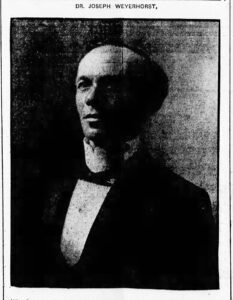
 A HUGE THANKS TO Facebook Page Alaska Mystery Pictures, Investigating the Unknown People.
One of the great scoundrels of the Alaska Gold Rush was Joseph Weyerhorst. But until this weekend there was no known photograph of the scurrilous doctor. Thanks to the intrepid research done by the members of the Alaska Mystery Pictures, Investigating the Unknown People, this photograph of the doctor was discovered. It was published in the Butte Intermountain on September 5, 1902. Weyerhorst was born in Belgium and received his medical degree from the University of Paris. He spent time in Nebraska and Montana before going to Nome where, apparently, he performed abortions. He left Nome for the boomtown of Fairbanks where the footnoted story of his follows:
In a sarcastic news item in July of 1906, the Fairbanks Daily Times reported how Dr. Joseph Weyerhorst had proven himself to be adept in “decorating his wife’s face with lasting remembrances of the impressionist.” Mrs. Weyerhorst had become disenchanted with her husband and moved out of their home to take a room in a local hostelry.[1] Her husband had tracked her down and when he could not convince her to return, had beaten her and then, in “a playful mood” had tried to “induce her to swallow a small towel.”
Rather than face trial, Dr. Weyerhorst jumped bail – to the annoyance of two local men who had posted his bail because his trunk of “surgical equipment” left as security was found to empty.[2] The Doctor had then fled on the steamer Sarah to St. Michael where he was apprehended and returned to Fairbanks. (The cost of his attempt to flee justice, $400 according to the November 11, 1906, Fairbanks Times, was later paid by the doctor.)
There was reason for the doctor to flee justice. Though he had only been in Fairbanks a short time, he had raised enough suspicion that the law enforcement officials had run a check on him, such as they were in 1906. The results of that background investigation revealed that a “careful eye” should be kept on him “where there was any substantial evidence he would have bumped against an indictment.” His crime in that previous local is not stated plainly. Rather, the Fairbanks Times stated cryptically, “He was not a fellow Roosevelt’s belief in race perpetuation.”[3] [Author’s note: This might be taken to mean that he was an abortionist.]
Additionally, in June of 1906 he was charged with malpractice for the death of F. G. Brose who apparently died while undergoing surgery. Weyerhorst claimed that Brose had died of “fatty degeneration of the heart and to congested lungs” which had nothing to do with his surgical skills. He also produced a certificate to prove that he had graduated from a medical school in Belgium. When asked about his incisions, Weyerhorst admitted to two. One was for the operation while the man was alive. The second, Weyerhorst claimed, had been performed “after death and said this was done for scientific purpose.”[4]
At the time of his arrest and subsequent flight from justice, he had left at least one patient in his sanitarium. Her name was Mrs. Minnie Robinson. She had fallen down her stairs weeks before and had gone to a local doctor who wired her broken jaw shut and stated that was all he could do. Then “along came Dr. Joseph Weyerhorst with a blaze of trumpeters, himself playing solo bugle” and convinced the woman to part with $250. He wrote out a guarantee and had the woman transferred to his sanitarium across the river where he “performed the operation of putting sundry bandages on the jaw to hold it in place – and keeping her from crying for help.” Claiming that he had a patient on “Ester Creek suffering from gas,” Dr. Weyerhorst left Fairbanks with her $250 in his pocket. Two days later, Mrs. Robinson was released from her bandages and taken to a local hospital.[5]
At his trial for assaulting his wife, a “letter of introduction” for Weyerhorst was then presented to Judge Erwin by Fairbanks Chief of Police Hagan. At his trial, Weyerhorst stated, “I life my vife und hev lofed her for – let me see – yoost 12 years und six months day before yesterday.” When it was the Judge’s turn, he waxed eloquently on Cicero, the Ceasars, “the Appian Way and other pikes traveled by progress,” Christianity and concluded
I regret, sah, that youh wife was not heah to testify against you, sah. But sah, I understand she is afraid you will kill hur. I am convinced that huh absence is due to huh feah that she will suffuh great bodily hawm in the futuah.
After he had completed his statement, Judge Erwin ordered Dr. Weyerhorst to pay a fine of $100. Before the Judge had even completed the sentence, Weyerhorst “swung his arm over the chair as if he was about to spring the old gag about having that much in his hip pocket.” Then the judge finished the sentence, “. . . and fifty days in jail.”
Weyerhorst’s brushes with the law were newspaper grist. He had been accused of removing a healthy appendix and causing a patient to die earlier that year. This fact the newspaper used as part of its humorous report of the case. “Having fully diagnosed the doctor’s case, [Fairbanks Chief of Police Hagan] decided that instead of removing the appendix he would take the whole thing away.” Weyerhorst was then taken to jail.[6]
The next report on the elusive doctor was two years later, May of 1908 when he was charged with practicing medicine without a license – and filed for divorce in Nome. Dr. Weyerhorst charged is wife with “intoxication, unfaithfulness and desertion” among “many other reasons.” Apparently his wife was still living in Fairbanks where she had become a “habitue of the Flora Dora dance hall” where she made her living as “dance hall girl.”[7]
Weyerhorst was then able to stay out of the public eye until 1911 when he was charged with practicing medicine without a license in Douglas. The next year he was back in the news, this time for removing a woman’s ovaries and, in the process, maiming her. On April 27, 1918, he was charged with obstructing recruitment during the First World War because he would not perform a physical. There was also a second count. He was alleged to have said to a potential inductee, “I could remove your eye and then you wouldn’t have to go.” His trial resulted in a hung jury on June 5, 1918. He was tried a second time and found Not Guilty on June 9, 1918. (Ironically, Weyerhorst had been appointed to the Selective Service Exemption Board for Douglas in August of 1917.)[8]
Weyerhorst died in October of 1921 in Great Falls, Montana where he was working as a physician for miners and running a small hospital. His wife claimed his estate of $875, unusual inthat his death certificate lists him as “single.”[9]
[1]“Local Doctor under Arrest,” Fairbanks Times, July 28, 1906.
[2]“Still After the Doctor,” Fairbanks Times, August 30, 1906. The author assumes that the trunk was empty. In fact,
the news article actually said that when the trunk was opened it was found to contain “the doctor’s principal stock in trade” rather than his surgical instruments.
[3]“Still After Doctor,” Fairbanks Times, August 30, 1906.
[4]“Case goes to the Jury,” Fairbanks Evening News, June 27, 1906.
[5]“Dr. Joseph Weyerhorst Gone,” Fairbanks Daily Times, August 29, 1906; “Still After Doctor,” Fairbanks Times,
August 30, 1906; Fairbanks Criminal Case #174.
[6]“Got Benefit of the Limit,” Fairbanks Times, July 29, 1906; “No Blame on Doctor,” June 28, 1906,
Fairbanks Times; “Inquest is Held,” June 27, 1906, Fairbanks Times. Of note, two issues discussed at the inquest were 1) the size of the incision to remove appendix and 2) whether the doctor and his wife had removed their rings before the operation. The name of the deceased was Fred G. Brose. Brose died at the Weyerhorst Sanitarium. A full page advertisement for the sanitarium can be found in the Fairbanks Times on June 5, 1905.
[7]“Weyerhorsts in the Divorce Court,” Tanana Tribune, May 30, 1908 and “Has New Troubles to Face,”
Yukon World, Dawson, January 18, 1908.
[8]Juneau Criminal Files 771, 894, National Archives, Seattle.
[9]“Dr. J. Weyerhorst Dies Tuesday A. M.,” Great Falls Tribune, October 12, 1921. Weyerhorst’s death certificate
does not give any leads to the historian. He was listed as “single,” and “about 50.” His father is listed as “—— Weyerhorst” with a birthplace as “Holland.” His mother is listed as “unknown” and her nationality as “unknown.” He had moved to Montana three years before his death.